




Here’s What the Shutdown Will Cost
• 3 min read
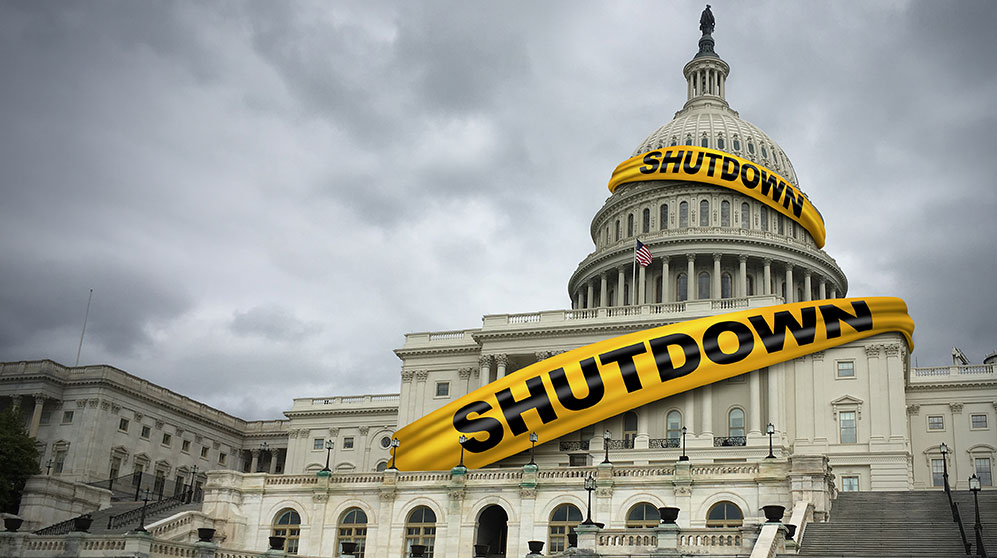
Every week of the government shutdown has a cost; here’s what the U.S. economy will pay.
Get the Latest Research & Insights
Sign up to receive an email summary of new articles posted to AMG Research & Insights.
What’s the overall economic impact of the government shutdown now entering its fourth week? A reasonable but rough estimate would be a 1.5 percentage point cut in fourth-quarter real GDP growth for every week of the shutdown, according to an AMG analysis.
Annual federal government funding needs congressional approval of 12 appropriations bills by Oct. 1 that apply to distinct functions of the government. This year, not one has been passed. As a result, most federal agencies are shut down, exceptions being allowed for functions considered to be essential, such as those involving public safety or property protection.
The Republican majority in the House of Representatives has passed a stopgap funding measure. However, the bill has failed multiple votes to advance in the Senate, as Democrat opposition has left the majority in favor short of the 60 votes required to move the bill forward. Democrats insist that before approving any annual appropriations, Republicans must agree to override certain health-care cuts included in the One Big Beautiful Bill Act. The Republicans have so far refused to do so. The main sticking points are Democrats’ desire to extend enhanced “temporary” Covid-era subsidies for purchases of medical insurance, as well as doing away with work requirements for able-bodied subsidy recipients and restoring medical subsidies for some immigrants. So far, both sides are standing firm.
The Congressional Budget Office (CBO) has estimated that around 750,000 federal employees could be furloughed each day. They are not allowed to report for work and receive no pay for the duration of the shutdown. A similar number could be required to report for work without pay. Legislation passed in 2019 codified the government’s previous practice of paying both working and furloughed employees for the shutdown period. That is being questioned by the Trump Administration, which contends it’s unclear that non-working employees must be paid and it has the right to permanently lay off some furloughed workers.
The direct economic impact of the shutdown is the permanent loss of government services not provided by furloughed employees. The value of such services is recorded in the National Income and Product Accounts (NIPA) simply as the cost of labor. Since the NIPA is on an accrual basis, essential employees working with deferred pay are counted in the calculation of GDP. Because furloughed employees do not work, the amounts that they would otherwise be paid—$400 million per day, by the CBO’s estimate—are not entered into the NIPA. The shutdown will also induce indirect economic effects, which cannot be independently observed. Some of these, for example, would include the disruptions to business that are caused by the failure of affected agencies to timely issue permits or licenses required by law or regulation to operate, delays in judicial proceedings and rulings, and reduced spending by federal employees whose pay is delayed. An even larger impact may result from depressed consumer and business spending due to uncertainties and suppressed economic confidence.
HOW AMG CAN HELP
Not a client? Find out more about AMG’s Personal Financial Management (PFM) or to book a free consultation call 303-486-1475 or email us the best day and time to reach you.
This information is for general information use only. It is not tailored to any specific situation, is not intended to be investment, tax, financial, legal, or other advice and should not be relied on as such. AMG’s opinions are subject to change without notice, and this report may not be updated to reflect changes in opinion. Forecasts, estimates, and certain other information contained herein are based on proprietary research and should not be considered investment advice or a recommendation to buy, sell or hold any particular security, strategy, or investment product.
Get the latest in Research & Insights
Sign up to receive a weekly email summary of new articles posted to AMG Research & Insights.