




The Capital Gains Tax Dilemma of a Concentrated Stock Position
Perhaps you accumulated company stock over a long career. Maybe you invested in a company years ago and watched its value rise substantially. Or recent gains have simply caused one holding to become a much larger share of your portfolio than you intended.
Whatever the reason, a concentrated stock position can leave you facing a difficult question: Should you sell some shares, realize the gain and pay the tax, or keep holding in hopes of deferring, reducing or potentially avoiding capital gains taxes?
At first, this looks like a math problem. But investment decisions to manage risk involving a concentrated position rarely depend on taxes alone.
Should I sell appreciated stock and pay the capital gains tax?
There is no universal answer, but there is a reliable framework: if a single position has grown large enough that a decline in that stock would materially affect your financial plan, the risk of concentration may deserve more weight than the tax bill. Capital gains tax is a real cost, but it is a known, one-time cost. Concentration risk is an ongoing, unknown cost that continues for as long as the position is concentrated. In many cases, the right approach is not “sell everything” or “hold everything”—it’s a tax-aware plan to reduce the position gradually while preserving flexibility.
When Does a Successful Investment Become a Concentrated Position?
There is no single percentage that determines when a single stock position becomes a concentrated position. What matters is how much of your wealth—and potentially your financial future—depends on the performance of a single stock. The larger the concentrated holding, the more it may be relevant to consider that exposure alongside your other assets.
That can be particularly important for high-net-worth investors. A corporate executive, for example, may have not only substantial company stock, but also salary, bonuses, deferred compensation and future equity awards tied to the same employer. A longtime investor may have accumulated unrealized long term capital gains associated with the stock position that could translate to a significant tax liability, making selling daunting from a tax perspective.
In either situation, the investment can be considered as part of an overall wealth and asset allocation, rather than as an isolated holding.
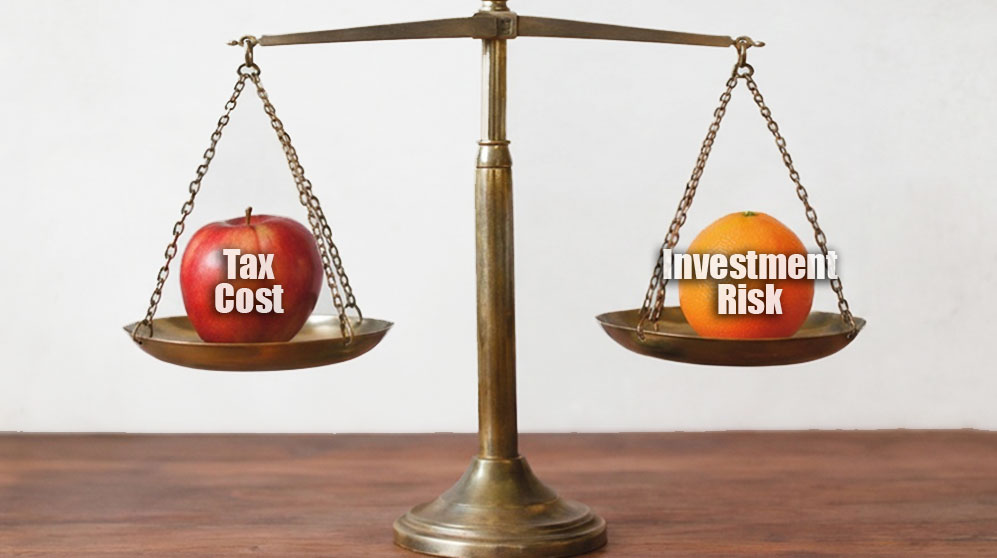 Weigh the Tax Cost Against the Investment Risk
Delaying taxes can add value because money that would have gone to taxes stays invested. But the benefit may be smaller than many investors expect because deferral usually postpones the tax rather than eliminates it. Its value generally depends on the size of the gain, your expected return, and how long you can hold the investment.
As a rough example, deferring tax on a 20% gain for 10 years at a 7.5% annual return may add about 4% in total value, or about 0.4% per year.
The other side of the calculation is concentration risk—the risk created when a single stock represents an outsized portion of your investment portfolio. The larger the concentrated position, the more one company’s performance can influence the results of the overall portfolio.
If the stock is volatile, overvalued, or now represents too much of your portfolio, holding only to minimize capital gains taxes can actually be costly. A future decline could erase part—or all—of the gain you are trying to protect.
For an investor with substantial wealth tied to one company, continuing to hold may leave a significant risk tied to the performance of one company. Investors should consider a different question: How would a significant decline affect your broader financial plan?
A loss could affect retirement income, liquidity for a major purchase, charitable plans or the amount you eventually transfer to your family. The relevant comparison, therefore, isn’t simply tax versus no tax. It is the potential value of tax deferral weighed against the investment and financial-planning risks of continuing to hold a concentrated stock position.
Diversifying a Concentrated Stock Position Doesn’t Have to Be All or Nothing
Reducing a concentrated position does not necessarily mean selling everything at once.
To help manage risk, you might consider selling enough to reduce the concentration to move toward a more diversified portfolio, rebalance toward your target asset allocation or fund near-term goals. Depending on your circumstances, you may also be able to spread sales across tax years, use capital losses or tax-loss harvesting to offset gains with investment losses or donate appreciated stocks to a donor advised fund or a charity that is already part of your plan.
For larger positions, additional tools are sometimes available. Exchange funds allow investors to contribute concentrated shares to a diversified pool alongside other investors, which can defer taxes while furthering diversification—though these vehicles typically carry eligibility requirements, lock-up periods and costs of their own. A charitable remainder trust can allow appreciated stock to be donated while still providing the donor an income stream. AMG has worked with clients on similar trust-based strategies—for example, funding a charitable trust with a concentrated stock position to reduce concentration risk while advancing a philanthropic goal. And for corporate executives and other insiders, a 10b5-1 trading plan can allow shares to be sold systematically and on a pre-set schedule, which may reduce both compliance risk and the temptation to time individual trades.
For high-net-worth investors, each of these approaches carries its own tradeoffs, and the decisions can cross several areas of wealth planning. Investment strategies, tax considerations, charitable giving, estate planning and cash-flow needs may all affect how—and how quickly—you choose to diversify a concentrated position. Some approaches may offer potential tax advantages, but those benefits should be considered alongside investment risk and your broader goals. They may be more easily evaluated in one place, with an advisor who sees your complete financial picture, rather than piecemeal across separate specialists.
Future tax rates and changes in tax laws also matter. If long-term capital gains rates fall, selling later could help. If they rise, waiting for future stock sales may reduce the value of deferral. For some investors, holding appreciated shares until death may allow heirs to receive a step-up in cost basis, potentially reducing long term capital gains taxes. But that strategy can require living for years with a concentrated position that may underperform or lose value.
When Holding Appreciated Stock May Still Make Sense
Diversification should not be an automatic response simply because a position has appreciated.
If the company remains financially sound, the investment continues to fit your long-term strategy and the position does not create unacceptable risk within your overall financial plan, selling too quickly may also be a mistake.
That is why concentrated stock management is highly individual. Two investors holding the same stock with the same unrealized gain could reasonably reach different conclusions based on their other assets, tax circumstances, liquidity needs, time horizons and financial goals.
Look Beyond the Investment Portfolio
For investors with significant wealth, the decision can become more complex because the stock may represent only one part of the relationship with the company.
For a corporate executive, the concentration may extend beyond the shares already held in an investment portfolio. Company stock, options, future equity awards and other elements of a compensation package may tie both current wealth and future income to the same company. That can make reducing concentration an important part of a broader investment strategy rather than simply a decision about whether to sell one stock.
Founders and business owners may have personal or family considerations associated with continuing ownership. Other investors may have trusts, charitable objectives or estate plans that are affected by when and how assets should ultimately be transferred.
Looking at those pieces together can help determine whether maintaining the position continues to serve your larger financial plan—or whether reducing it would provide greater flexibility.
Questions to Ask Before You Sell—or Hold
Before deciding what to do with a concentrated stock position, consider:
- How much of your overall wealth depends on this investment?
- What is the unrealized gain, and what might the tax consequences be if you reduce the position?
- How would a significant decline affect your financial plan?
- Could you reduce the position gradually or coordinate sales with other tax or charitable strategies?
- Apart from the tax consequences, what are the reasons for continuing to own this much of the stock?
Ultimately, the decision comes down to weighing two different kinds of cost against each other: the capital gains tax, which is real but known and one-time, and concentration risk, which is ongoing and uncertain for as long as the position remains oversized. Getting the balance right depends less on the exact math and more on how the position fits your liquidity needs, time horizon and estate goals. Framed that way, the tax bill becomes one factor to weigh—not the deciding one.
The practical answer is to balance tax efficiency with risk management. Don’t let the tax tail wag the investment dog. Taxes matter, but they should not override diversification, risk tolerance, long-term goals, and your broader financial well-being.
A wealth advisor can help evaluate the tax consequences of selling alongside the investment risk of continuing to hold, all in the context of your broader financial plan.