High Net Worth Doesn’t Always Mean Liquid Enough for Long-Term Care

• 11 min read

Photo of an older woman with a health care worker
Create options to build financial liquidity for unexpected life events.

Get the Latest Research & Insights

Sign up to receive an email summary of new articles posted to AMG Research & Insights.

Photo of an older woman with a health care worker

“We have substantial assets. We’ll be fine,” can be a reasonable belief among high-net-worth families when confronted with long-term care needs. Yet the real concern is rarely total wealth. Rather, the question is whether you hold sufficient assets beyond your illiquid holdings that can be easily accessed, deployed, and sustained without unintended consequences.

Many investors often face a dilemma of having significant wealth but low liquidity, which can lead to financial stress despite a seemingly impressive net worth.

The lack of liquidity planning is compounded by the likelihood of having no real warning of an illness until the diagnosis, and rarely knowing the potential price tag for care. Issues can surface when options are fewer and stress is highest, setting the stage for strife among family members and inopportune decisions that could risk turning care options into financial negotiations.

Preparing for potential life events such as a debilitating illness should be part of your proactive wealth management and estate planning. AMG’s most recent life report, “Secure Your Wealth and Live Well with a Dementia Diagnosis,” can help families prepare and care for loved ones with this or other crippling events.

Request a copy or ask an AMG advisor about other reports that may be of interest. 

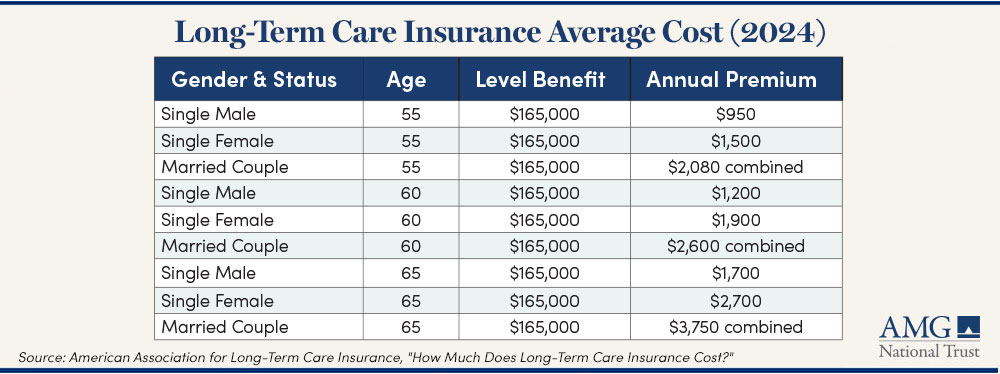
Table showing Long-Term Care Insurance Average Cost (2024), as outlined in text below

Reality of Illiquid Assets

High net worth often brings opportunity—and complexity. In fact, wealth is often created through at least some planned illiquidity—a concentrated stock position, inheritance, or having your own business. As wealth grows, your financial planning will likely aim to diversify it across a wider range of assets, including illiquid investments such as a family business, commercial or residential real estate investing, private equity, venture capital, fine art, or collectibles.

These assets could have a high appraised value, but converting that value to a liquid (e.g., cash) asset may take considerable time and effort. For example, a business sale may require months or years of preparation, negotiation, and due diligence, and the process can be especially demanding if waiting too long to act leads to rushed decisions. Real estate transactions can be slowed by market conditions, financing constraints, or regulatory hurdles. Private investments often include lock-up periods or limited secondary markets. Even high-value collectibles or fine art depend on finding the right buyer at the right time. At the point when liquidity is needed most—such as after a death or major event—illiquid assets, like real estate, can create significant challenges for heirs, who may need to sell these assets quickly to cover estate tax obligations.

The ultimate goal is to ensure that a long-term care event is paid for through a structured plan that maximizes tax efficiency and preserves the overall estate and wealth transfer goals.

Care Costs Continue to Rise

Planning ahead for the cost of long-term care requires an acknowledgement that treatment could become progressively more intensive and expensive, with little certainty about how the course of an illness or care requirements will change over time. The cost can be above $100,000 per year for higher levels of care, such as for a private room in a nursing home facility. Also consider that the cost of care continues to rise—total U.S. health expenditures reached about $4.8 trillion in 2023, more than triple the amount from two decades earlier.

For those who don’t think it can happen to them, an estimated 56% of Americans turning 65 between 2021 and 2025 are likely to experience a long-term care event, according to a recent federal study. Relying on hope alone for care planning is risky; proactive strategies are essential to address these likely needs.

Medical care is often compounded by comorbidity issues that increase needs for health care services such as diagnostics, medications, hospitalizations, and specialized care.

Attitudes toward care planning can be shaped by experiences and perceptions formed in the early years, influencing how individuals approach these decisions later in life.

Aging also impacts the cost, but not equally. The average life expectancy for U.S. women is 80.2 years, as of 2022. That’s nearly six years longer than for men. (These numbers are an increase over 2021 but do not fully offset a decline during the COVID-19 pandemic.) As women continue to outlive men, they are more likely to live at home when they are older and may need care services for longer. Proactive life care planning allows for home modifications that enable aging in place, often a preferred but expensive option.

Tax Drag Can Undermine Liquidity

Tax drag refers to the impact of taxes on investment returns, such as capital gains, dividends, and interest income. Over time, that reduces how much of a portfolio is available to compound—and how much is readily accessible when cash needs arise.

This becomes especially important in the context of long-term care. For many investors, liquidity must be created by selling appreciated assets—whether from a stock position, a business interest, or real estate. The result: a meaningful portion of the proceeds can be lost to tax drag at precisely the moment funds are needed. In addition to triggering significant capital gains, selling appreciated assets to pay for care can also eliminate a step-up in basis for heirs.

Preparations and Potential Safeguards

The solution is not necessarily reducing exposure to illiquid assets but ensuring that sufficient liquidity exists elsewhere in the financial plan. It is critical to work with your financial advisor early on to develop a strategy that reflects your values with respect to your care and your estate plan.

Below are some options that AMG includes in discussions with clients to get a sense of preferred ways to meet their unique needs.

Long-Term Care Insurance

Traditional, private health insurance may not cover assisted-living or similar long-term care, though providers may cover some medical services within such a facility. In response, long-term care insurance (LTCI) has evolved to be similar to some life, home, or auto policies—offering a range of policy options where you can choose the coverage that fits your circumstances.

For high-net-worth families, LTCI could be considered more of a liquidity planning tool than as risk protection—protecting the balance sheet while maintaining flexibility.

LTCI also generally has a use-it-or-lose-it structure, meaning that if long-term care services are never needed, you do not get any money back. Policies typically kick in when the policyholder is unable to perform at least two activities of daily living and can pay for in-home care, nursing home stays, adult day care, and assisted living facilities.

The level of coverage and your age are among the factors that determine the monthly policy premium you pay the provider.


Those uncomfortable with the use-it-or-lose-it nature of LTCI may prefer the option of a permanent life policy with an LTCI rider. This hybrid policy would pay for LTCI as needed, or a death benefit if LTCI is never needed. However, the cost may be greater than for an LTCI policy, and the overall benefits may be less.

Finally, only the LTCI portion of the premium typically can be considered for a tax deduction (to the extent total unreimbursed medical expenses exceed 7.5 % of adjusted gross income) versus the full premium for an LTCI policy.

Self-Insuring by Building Liquidity Reserves

Image of related article, "FInancing Long-Term Care"Self-insuring involves using your own resources to build a financial cushion for care or other unexpected needs. This means building a liquidity reserve within the overall financial plan—assets that can be accessed quickly without forcing the sale of a business, real estate, or long-term investments. Many high-net-worth individuals establish dedicated liquidity reserves specifically to cover 3–5 years of potential care costs, which helps prevent the need to liquidate long-term growth investments.
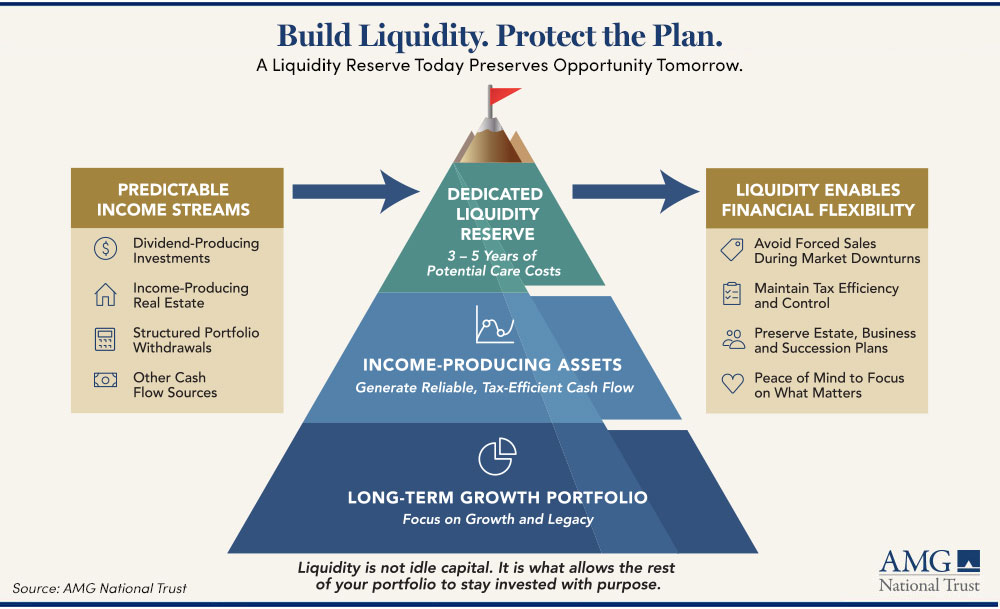


A well-designed liquidity strategy focuses on generating reliable and tax-efficient cash flows. These may come from dividend-producing investments, structured portfolio withdrawals, income-producing real estate, or other assets designed to convert wealth into resources available when needed. Establishing a tiered portfolio framework with highly liquid investments can also prevent forced sales of growth assets during market downturns, allowing the rest of your portfolio to recover and grow over time. This approach provides peace of mind and the ability to rest, knowing that liquidity needs are met without unnecessary stress or disruption.

Doing so may avoid forced sales, unfavorable tax consequences, or disruptions to estate plans, business succession strategies, or philanthropic goals.

Infographic explaining how a liquidity reserve today preserves opportunity tomorrow.

Establish a Trust

A trust can be helpful in some instances but depending on the assets involved or how they are invested, illiquidity issues could still arise.

If using a revocable trust, you could revoke or amend part of the trust in order to remove the assets needed to satisfy your liquidity needs.

 A Spousal Lifetime Access Trust could support a surviving spouse’s care, or an irrevocable trust could own a life insurance policy, with the proceeds eventually flowing into the trust. The trustee could also be instructed to provide a certain amount of income each month when needed for the couple’s care.

Explore a Home Equity Line of Credit

High-net-worth individuals with substantial home equity, especially those who have paid off most or all of their mortgage, may be able to use a home equity line of credit (HELOC) as a flexible source of liquidity. Compared to more complex alternatives, using a HELOC can be as simple as drawing funds when needed—there’s not all the hassle involved with selling investments or restructuring portfolios.

A HELOC could be likened to an insurance premium that you may never need but is in place as a precaution—providing immediate access to capital without having to sell assets and triggering a tax event.

Beyond the initial costs and potential annual fee, there may be an inactivity fee if the HELOC is not used over a given year. However, there also is no interest due unless the HELOC is accessed.

AMG Can Help Identify and Coordinate Liquidity Goals

Possessing substantial assets does not necessarily mean you have the financial liquidity to handle unexpected events. The allocation of illiquid and liquid wealth will generally play a role in any high-net-worth financial planning and should be tailored to your unique needs. That planning should include various scenarios, such as an assessment of the need for long-term care, and how to fund it. Think of this as a contingency plan of sorts that identifies which assets will be used to fund care, thus reducing emotional decision-making during a crisis.

AMG can help identify and coordinate liquidity goals, ensuring that long-term care and other needs can be satisfied without endangering their family’s wealth and security or your legacy goals. Aligning spending with liquidity objectives is crucial to avoid tax inefficiencies and liquidity shortfalls.

Not a client? Find out more about AMG’s Personal Financial Management (PFM) or to book a free consultation call 303-486-1475 or email us the best day and time to reach you.

FREQUENTLY ASKED QUESTIONS

Effective strategies typically involve creating a dedicated pool of liquid assets—such as dividend-generating investments or structured withdrawal plans—that can be accessed without disrupting long-term holdings. Many investors prioritize cash flow and income over growth in the early stages of investing, but it is important to balance this with long-term growth strategies to avoid being cash poor while equity rich. Building wealth for future needs requires careful long-term planning, not just focusing on asset accumulation. In fact, many investors with high equity but low liquidity find themselves stressed over small expenses, highlighting the importance of cash flow management in relation to net worth. Relying on hope for future liquidity or care needs is risky; proactive planning is essential. Some individuals also use long-term care insurance to supplement liquidity and protect the broader portfolio.

  • Build a liquidity reserve within an investment portfolio designed to generate reliable, tax-efficient cash flow
  • Structure income from dividend-paying equities, bonds, or income-producing real estate
  • Incorporate long-term care insurance as a way to offset large, unexpected care expenses

Yes, a trust can be a tool for funding long-term care, particularly when it holds liquid, income-producing assets and includes provisions for health, maintenance, and support.

However, trusts come with important limitations. Some wealth held in trust may still be illiquid, distributions often require approval from a trustee, and modifying trust terms can be complex or require legal involvement. For these reasons, trusts are most effective when paired with proactive liquidity planning—before a health event occurs.

REQUEST REPORT

Download this free 16-page report to learn how to prepare and care for loved ones with dementia or other crippling events.

This information is for general information use only. It is not tailored to any specific situation, is not intended to be investment, tax, financial, legal, or other advice and should not be relied on as such. AMG’s opinions are subject to change without notice, and this report may not be updated to reflect changes in opinion. Forecasts, estimates, and certain other information contained herein are based on proprietary research and should not be considered investment advice or a recommendation to buy, sell or hold any particular security, strategy, or investment product.

Get the latest in Research & Insights

Sign up to receive a weekly email summary of new articles posted to AMG Research & Insights.